
Why Your Questions Aren’t Getting Change Talk (And What to Do Instead)
You’re Asking the Right Kind of Questions… So Why Isn’t It Working?
If you’ve been trained in Motivational Interviewing (MI), you already know the basics:
Ask open-ended questions
Avoid yes/no prompts
Let the client do the talking
And yet…
You ask what feels like a “good” question, and the response falls flat.
No insight.
No movement.
No change talk.
So what’s going on?
It’s not that you’re asking the wrong type of question.
It’s that your questions may not be doing anything.
The Real Issue: Not All Questions Are Created Equal
A common trap is focusing on form over function.
We start thinking:
“Was that open-ended?”
“Did I phrase that correctly?”
But MI isn’t about asking technically correct questions.
It’s about asking questions that move the conversation somewhere meaningful.
Because here’s the truth: A question can be open-ended… and still go nowhere.
Why You’re Not Hearing Change Talk
Let’s simplify it.
Change talk doesn’t show up just because we ask a question.
It shows up when a question guides someone to reflect in a new way.
If your questions are:
Too broad
Too safe
Too focused on information gathering
You’ll likely get surface-level answers.
But when your questions:
Evoke reflection
Highlight discrepancy
Reinforce autonomy
That’s when things start to shift.
What This Looks Like in Practice
Here’s the difference.
❌ Weak Question:
“What do you want to change?”
Technically open-ended.
But it often leads to:
“I don’t know”
“Everything”
“Nothing”
It doesn’t give the person anywhere to go.
✅ Stronger Question:
“What concerns you most about how things are going right now?”
Now we’re getting somewhere.
This question:
Directs attention
Invites reflection
Opens the door for change talk
Let’s look at a few more.
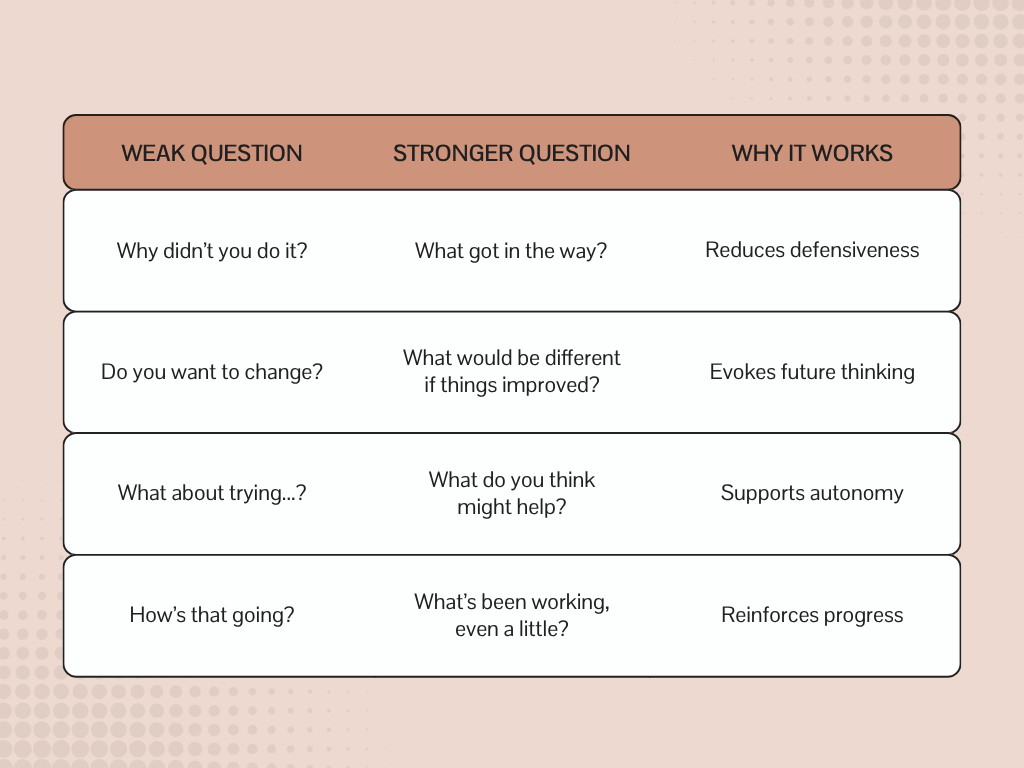
A Real-Life Example (That Has Nothing to Do With Therapy)
I was driving my 13-year-old son home from baseball practice the other day.
I asked him what they worked on. He said pitching.
Like a lot of middle school boys, he has a solid amount of confidence—not in a boastful way, just in a “I don’t really see the negatives” kind of way.
So I asked:
“What’s one thing you feel you’re doing well with your pitching?”
He said:
“My accuracy. I threw a lot of strikes.”
Then I followed up:
“If there was one thing you could improve, what would it be?”
He said:
“My velocity… I mean it’s not bad, I throw pretty fast.”
So I asked:
“How would you rate it on a scale from 1–10?”
He said:
“9.”
(Confident, as expected.)
Then I asked:
“What would make it a 10?”
After a moment, he said:
“I could be a little faster if my arms were stronger.”
That right there—that’s change talk.
Not because I told him what to do.
Not because I corrected him.
But because the questions helped him say it himself.
Now imagine if I had said:
“You need to work on your arm strength.”
“You’re not as fast as the other kids.”
I would have gotten pushback.
Probably a lot of it.
Instead, the conversation did the work.
The Shift: From Asking Questions → Guiding Conversations
This is where many clinicians get stuck.
They think:
“I just need better questions.”
But what actually matters is:
What is this question helping the person see, feel, or consider?
Motivational Interviewing isn’t about asking more questions.
It’s about asking questions that:
Guide without pushing
Invite without overwhelming
Create space for the person to hear themselves
“What is this question helping the person see, feel, or consider?”
A Simple Way to Improve Your Questions Today
Before you ask a question, pause and ask yourself:
“Where is this question leading?”
Is it:
Gathering information?
Or guiding reflection?
If it’s not leading anywhere… it’s probably not going to create change talk.
Final Thought: It’s Not About Getting It “Right”
One of the things I’ve noticed in recent trainings is how hard people are trying to get MI “right.”
They’re focused on:
The wording
The structure
The technique
And in doing that, they miss the nuance.
Motivational Interviewing isn’t about perfection.
It’s about connection, intention, and direction.
And sometimes, a small shift in how you ask a question can completely change what comes next.
Want Help With What to Ask in the Moment?
If you’ve ever found yourself thinking:
“I know what MI is… I just don’t always know what to say,” that’s exactly why I created 50 Questions to Ask.
It’s a practical tool you can use in real conversations— to move from surface-level responses to meaningful change talk.
👉 Get your copy HERE!
